The different types of folds explained simply
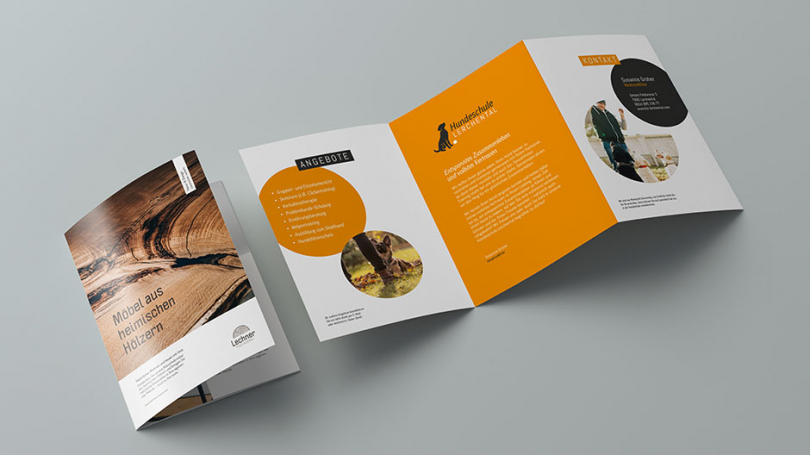
Brochures, leaflets, flyers and the like – we all know and love them. Not only are they practical and compact in size, shape and ease of use, but they’re also the perfect promotional tools for bringing together all sorts of information in one place. How can such a small piece of paper present so much information in an organised way? It’s all down to the fold! But what exactly is a fold? And, above all, why are there so many different types of folds? In our guide to the basics of fold types, you’ll find answers to all your questions!
What is a fold?
Put simply: the fold is the crease in your leaflet! A fold is therefore the edge along which the paper is mechanically creased. The individual folds ensure that your promotional materials are divided into several pages, allowing you to present your information in the best possible way.
What is the difference between folding and creasing?
Folding isn’t the same as creasing. The difference: with folding, you use your hands; with creasing, the machine does it. So you’ll rarely say, ‘I’ve creased an origami swan.’ Stick to saying, ‘Have a look at the brilliantly creased folders from druck.at!’
How many folds are too many?
The answer: There’s no such thing as too many folds. It always depends on how much information your promotional material needs to convey. If you want to include just a little information, we recommend a standard single fold. If you have a lot of information and want to give your audience as much as possible, a Z-fold with 14 pages, for example, is recommended. Either way, the folds help you create enough space for your message!
druck.de Fun Fact: There are no limits when it comes to folding, but what about creasing? Did you know that you can only fold any sheet of paper, regardless of its size, seven times? This is because with every fold, the number of layers of paper doubles, whilst at the same time the surface area of the paper is halved. So after the seventh time, that’s it. Always. Why not give it a go at home with a sheet of paper?
An explanation of the different types of folds
With so many different types of folds to choose from, it can sometimes be difficult to keep track of them all. To help you work out which fold suits you and your message best, here’s an overview:
Single fold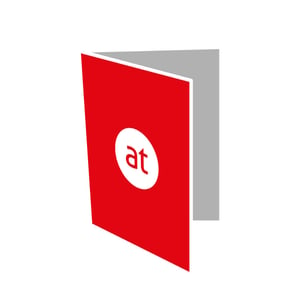
A Folder with a single fold This is one of the most common types of fold and, as the name suggests, is the simplest fold. The sheet of paper is folded once down the centre, creating a sort of folding card. This fold gives you a total of four pages: a front page, two inside pages and a back page.

Double parallel fold
The Double parallel fold is an extension of the single fold. The sheet of paper used for this is folded twice in the middle, parallel to each other. This results in 4 outer pages and 4 inner pages, with the first two outer pages forming the back cover and the front cover. The remaining two pages are folded into these.

Window fold open
In the case of a open window fold, also known as an altar fold, involves folding the two outer edges of the sheet of paper so that they meet in the centre. You can think of it as being similar to an old double-casement window. This type of fold creates a total of six pages: a front cover on the right and left, which together form the front cover of your closed folder, a back cover and three inside pages.

Window fold closed
A folder containing closed window fold is initially folded in a similar way to the open window fold, but is then folded again down the centre. This results in a total of four
Inner pages and four outer pages, with the two central outer pages forming the back cover and the front cover.

Cross-fold
The Folder with cross-fold This is also a very common method, frequently used by supermarket chains, furniture stores and the like for their postal advertising. In this case, the sheet of paper is folded twice in the middle to form a cross. This style is particularly suitable when you want to display large images or graphics and draw attention to them through their size.

Wrap fold, 6 pages or 8 pages
In the case of a 6-page wrap-fold The sheet of paper is folded in parallel a total of two times, with the left-hand outer side being folded inwards towards the other two sides. A 8-page wrap-fold It is folded in parallel a total of three times. The two outer pages resulting from this are also folded back inwards. The wrap fold is a common format for all kinds of information leaflets.
Z-fold with 6, 8, 10, 12 or 14 pages
Z-fold stands for ‘zigzag fold’ and, as the name suggests, is folded in a zigzag pattern. This means that the sheet of paper is folded in parallel, alternating directions. The number of folds depends on how many pages you would like: folded twice to produce a total of six pages, up to six folds to create a total of 14 pages. Regardless of the number of folds, the far-right outer side is always the front cover and the far-left outer side is always the back cover.