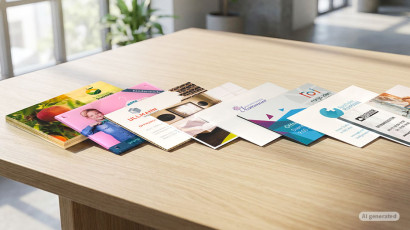
Get off to a flying start with a customer magazine!

Print is alive and well! Even in the age of digital marketing, the power of printed materials with customers remains as strong as ever! And we’re not just saying that because we’re a printing company. ;) There’s one printed product that allows you to get really close to your target audience: the customer magazine!
How you can benefit from a customer magazine

Added value: Customers appreciate a high-quality magazine featuring interesting and relevant articles. Unlike web content, which is consumed quickly, people take more time to leaf through a magazine. The information you share about the company and its products helps to forge an even closer bond with customers.

Trust: A magazine, printed on high-quality paper, makes a good impression on your customers. A magazine offers a glimpse behind the scenes and wins people over with its approachability, openness and transparency. Articles written in a journalistic style come across as more credible than pure advertising. This allows you to contribute to building a positive brand image.

Cost-effectiveness: Yes, even though you can’t measure it directly in the same way as with online marketing campaigns, this can help you increase your turnover in the long term. This personal touch builds trust, ensures your brand sticks in people’s minds and provides strong arguments in favour of your company and its products. At the same time, a customer magazine sharpens your own brand’s profile and sets you apart from your competitors.

Content rules: You can then post the articles from your magazine very efficiently across your content channels (blog, website, social media, etc.). This way, you can also benefit from your magazine as part of your digital marketing mix. And always bear one thing in mind: customers love high-quality content.
Step 1: How to get started with your customer magazine!
If you’re not part of the journalistic profession, the ‘customer magazine’ project can sometimes present a marketing team with one or two challenges. Many questions arise: What needs to be taken into account? How should everything be implemented? How much time is likely to be required?
You can either choose to outsource the project to an agency or a publisher, or carry it out yourself. This is where our tips can help.
It’s easier than you might think, provided you bear one thing in mind: a successful magazine is always the result of teamwork. Before getting started, it is best for a team comprising marketing, product and sales to meet. If the company has a service centre, this department should ideally be involved as well.

Step 2: Identify topics that will interest your readers!
In this team meeting, also known as an editorial meeting, it is decided which content should be covered. What do your customers want to read? Where can you offer added value? Dieser Punkt muss sehr gut recherchiert werden. Hier sind die Mails der Kunden und Kundinnen, Geschäftspartner:innen und Interessenten oder Interessentinnen, genauso wie Anfragen, die über Social Media & Co an das Unternehmen gerichtet werden eine gute Quelle der Inspiration. Erstelle daraus eine Themensammlung, die dann in unterschiedliche Bereiche, die sogenannten Ressorts, eingeteilt werden.
When it comes to content, a good mix of in-house and external topics works well. Depending on the sector you operate in, the magazine should either inform or entertain. For example, a customer magazine for a beauty brand will feature different content to that of a financial services provider.
Company-related topics
- Company news
- Partnerships
- Sponsorship
- Products & their uses
- Success Stories
- Events (trade fairs, anniversaries, awards, …)
Various topics
- Tips & tricks from the industry
- Interviews mit Experten und Expertinnen sowie Promis
- Competitions
- Recipes
Step 3: Defining the key parameters

How often should the customer magazine be published?
Das hängt in erster Linie davon ab, wie viele Inhalte du zusammenstellen kannst und natürlich auch vom Budget. Wir empfehlen gerade für den Anfang einen halb- oder vierteljährlichen Erscheinungsrhythmus. Später, wenn das Team eingespielt ist, kann man auch mehrere Erscheinungstermine einplanen.
How much time should be allowed for this?
Abhängig davon wie eingespielt ein Team ist, kann das Erstellen eines Kundenmagazins zwischen einem bis vier Monate dauern. Solltest du dich das erste Mal an ein Projekt dieser Größenordnung wagen, plane von der ersten Redaktionssitzung bis zur Abgabe in der Druckerei genug Pufferzeiten ein.
What organisational considerations are there?
Before you get started, you’ll need to decide on the following points for the first edition, based on the collection of topics. Depending on how many items are included and their length, choose the appropriate format as well as the desired paper type and binding.
Print run:
Überlege dir, an welche und wieviele Kunden und Kundinnen du das Magazin schicken willst. Oder soll es bei einer Messe bzw. im Shop aufgelegt werden? Wir raten dazu am Anfang eher mit einer kleineren Auflage zu starten, notfalls kannst du immer noch einen Nachdruck in Auftrag geben.
Format:
The standard format is usually A4, but smaller formats such as A5 can also be considered as an alternative.
Number of pages:
The actual number of pages naturally depends on the budget and the topics. However, one thing is very important: Always multiply the volume by four! Sollte dir zum Schluss genau eine Seite fehlen, kannst du diese nicht einfach anhängen. Du musst weitere drei dazurechnen. Es geht im Druckverfahren nicht anders, durch die Bögen muss man immer die Seitenanzahl durch vier teilen können. Verkleinere oder vergrößere einen Artikel in deinem Customer magazine as required.
Paper type
If you’re unsure which paper to choose, simply ask your trusted print shop for advice Paper templates. As a general rule: the more quality you want to convey, the higher the paper quality should be. By the way, here’s a little Paper guide for you.
Printing company:
Read through the specifications provided by your chosen print shop and create the document accordingly in a layout design programme. This could be Adobe InDesign, Microsoft Publisher or even Word. We recommend using a professional programme such as Adobe InDesign or QuarkXPress. More on this topic Print data creation You can also find these on our blog.
Layout
Lege fest, welche Fonts du für die Headlines und den Fließtext verwendest. Setze nicht zu viele Schriften ein, sonst entsteht ein unruhiges Layout. Aber arbeite nicht nur mit EINER Schriftfamilie - du willst doch nicht, dass deine Leser und Leserinnen einschlafen. Wichtig ist, dass alles gut lesbar ist. Bedenke auch, dass es Menschen gibt, für die eine kleine Schriftgröße schwer lesbar sein kann. Deswegen sollte die Schrift im Fließtext mindestens 8 Punkt betragen.
Keine Angst vor leeren Flächen! Stopfe nicht alles mit Inhalt voll, weniger ist oft mehr. Wenn irgendwo weiße Stellen entstehen, belasse sie. Überfordere den Leser oder die Leserin nicht. Entweder du lasst das Layout komplett von einem Professional Get started, do some research online or get yourself a layout template.
Step 4: How to create a page layout

The most important tool for planning, implementation and orientation is the page layout. It provides an overview of which content is scheduled for which page. This means that not only does the graphic designer responsible for implementing the magazine layout have a clear roadmap to follow, but so does the editorial team.
To plan your page layout, you should consider the approximate structure of the magazine and get a good overview of the individual content. Based on this, you can create individual layouts for your pages. This means, for example, deciding where to place your headlines, images or text. Important: Your content is not yet inserted into the page layout; it is simply represented by coloured blocks. To make this task easier, you can use programmes such as InDesign or Photoshop. However, you can also create your layouts the traditional way, with pen and paper. The page layout therefore reflects your actual magazine and provides the basic framework.
Step 5: On your marks, get set, go – and get typing!

Gerade wenn du zum ersten Mal eine Zeitung erstellst, solltest du schon wie vorher erwähnt ausreichend Pufferzeiten einrechnen. Hier mal eine grobe Übersicht, die du für deine Zwecke adaptieren kannst:
- Initial brainstorming: approx. 3–4 months before launch
- Regelmäßige Redaktionssitzungen am besten einmal pro Woche
- Research, writing & layout design: approx. 1–2 months
- Proofreading: 2–3 days before the print deadline
Dies ist nur ein Rohgerüst und eine Empfehlung. In der Realität kann natürlich vieles anders ablaufen. Rechne vor der Abgabe der Druckdaten noch am besten zwei Tage ein, damit alles passt. Plane aber auch genug Zeit für die Recherche ein, diese kann oft mehr Zeit in Anspruch nehmen, als das Schreiben eines Artikels.
Writer'Block: If you can’t immediately think of a catchy headline or a way to start an article, just start writing. Write down all the words without censoring yourself – just get them down on paper. This will give you a first draft; you can then refine the text in the next steps.
Step 6: Create the layout, revise the text and off to the proofreader!
Dann kommt der nächste wichtige Schritt. Der Grafiker oder die Grafikerin setzt das Layout auf, fügt die Bilder und Texte ein. Der Chefredakteur oder die Chefredakteurin redigiert die eingelangten Texte. Das heißt er oder sie schaut sich die Texte genauer in Sachen Stilistik und Plausibilität an. Wenn notwendig hält er oder sie Rücksprache mit den einzelnen Redakteuren und Redakteurinnen, die den Artikel gegebenen Falles überarbeiten. Dadurch wird die Qualität gesichert.
The most important thing in journalism is always: check, re-check and double-check. And that applies to customer magazines too. If, for example, you’re providing your customers with tips, they should be accurate. As a general rule, the more eyes that look over an article, the better.
Once everything is finalised and the text is correct, hand it over to a professional proofreader. They will iron out any errors that you’ve become blind to. After all, errors in the text detract from the quality of your magazine. Invest in having it professionally proofread – it’ll save you a lot of unnecessary hassle.
Step 7: Submission of print data
Now the time has come: you’ve finished the booklet and can send the print files to your trusted printer. But the best moment is when you hold the printed booklet in your hands for the very first time. There really is a special magic to it that’s hard to describe
We recommend you simply give it a go and hope you enjoy coordinating, writing and publishing.